
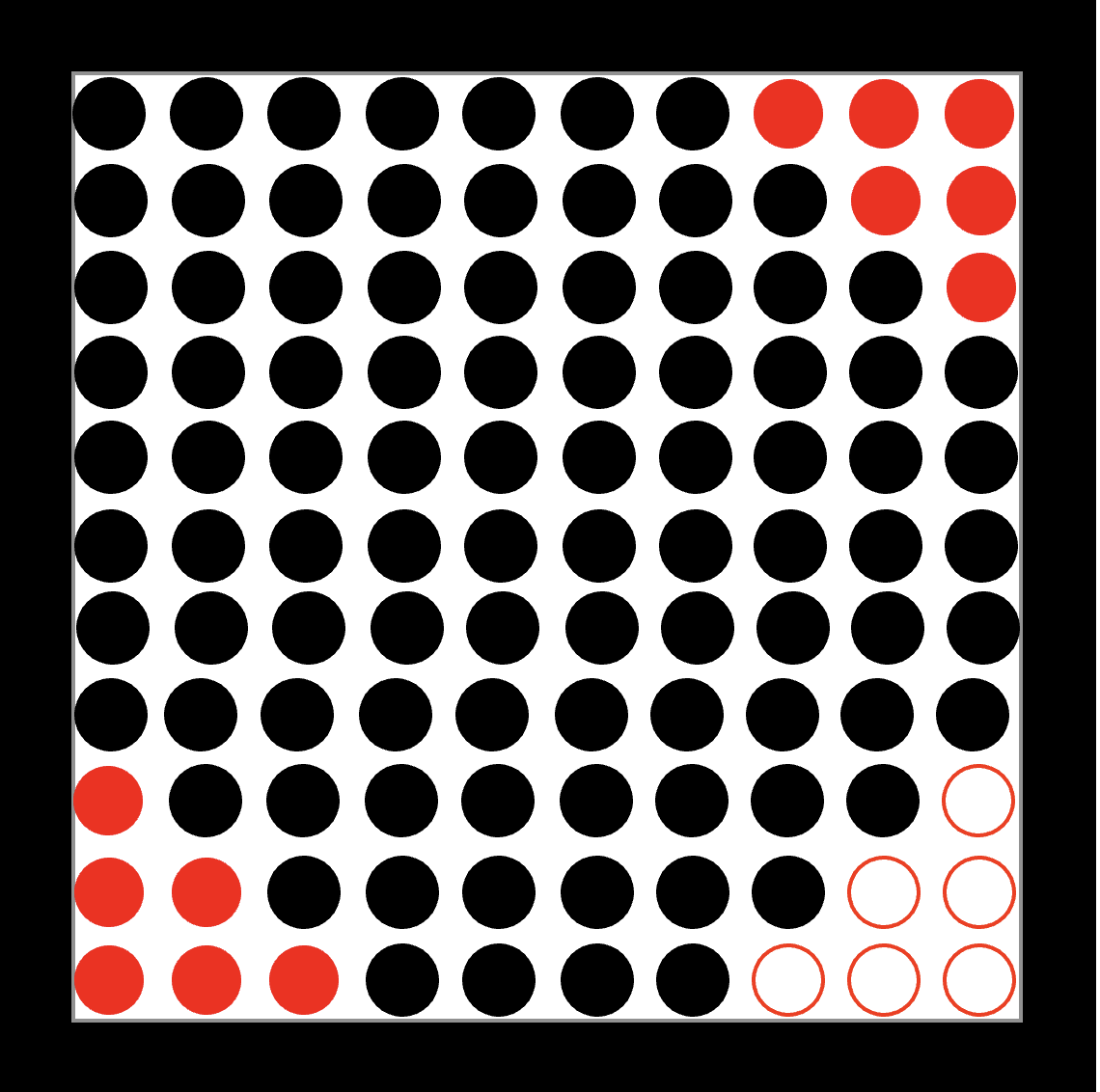
There are two ways we can improve children and young people’s experience of physical education. We can increase what is good by intentionally creating moments of meaning, enjoyment, progress, and connection. Or we can reduce what is harmful by systematically rooting out and removing abuse, alienation, bullying, embarrassment and injury. However the field often focuses on adding more without first addressing what undermines pupils’ positive relationships with their own bodies and movement cultures. Sometimes improvement is not about more activities or more initiatives, it is about doing less harm.
Chaotic (laissez-faire) teaching: the most harmful style for students’ psychological needs? by Arne Bouten and colleagues (2025) immediately caught my eye in my recent reading. It adds insight and nuance to the growing evidence of the dangers of controlling teaching in PE by investigating what sits at the other extreme, that of chaotic teaching. Far less attention has been paid to this style, but this study begins to address that by exploring its potential impact within PE.
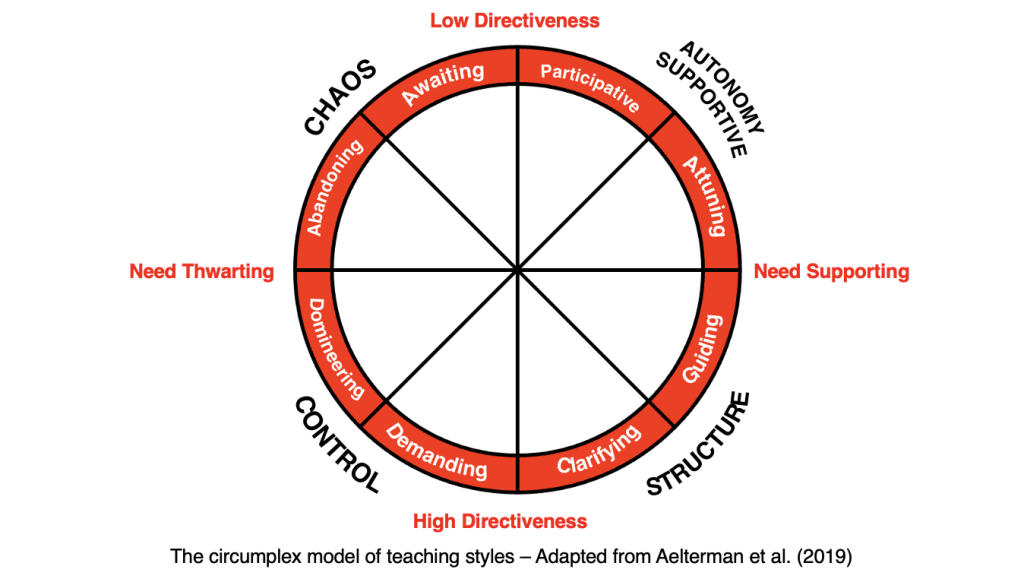
Before getting into the findings, it is worth understanding Aelterman et al.’s (2019) circumplex model of teaching styles. It is a helpful tool that positions teaching styles along two axes. The first dimension runs from needs thwarting to needs supporting. This connects directly to Self-Determination Theory and the three basic psychological needs of autonomy, competence and relatedness. These needs are the psychological conditions required for pupils to feel motivated, engaged and well in PE. Whether those needs are met or frustrated is shaped, in part, by how we teach. Needs supporting teaching nurtures pupils’ sense of control and direction (autonomy), helps them feel capable and of making progress (competence), and builds connection and care within the class (relatedness). Needs thwarting teaching, on the other hand, actively undermines them.
The second dimension moves from high teacher directiveness to low teacher directiveness. Directiveness refers to the extent to which the teacher leads, structures and directs the learning activities. When both dimensions are combined, we get four broad teaching styles: autonomy support, structure, control, and chaos. Each style includes two approaches, creating eight in total. The model is useful to see teaching not necessarily as a binary of “good vs bad”, but as a landscape of general teaching tendencies that are dynamic and tend to shift with context, habit and pressure.
The evidence base on controlling teaching styles within PE is growing. When pupils are pressured into behaving or thinking a certain way, relying on rewards, threats or subtle forms of coercion then this lead to higher levels of amotivation and lower levels of participation. Research using the circumplex model paints this clearly. In secondary PE context, Van Doren et al. (2025) found that lessons characterised by a controlling teaching style led to lower motivation and greater disengagement among students aged around 13-14. Diloy-Peña et al. (2021) reported that internal controlling behaviours such as guilt, disapproval or ignoring pupils were strong predictors of them reporting “bad” or “very bad” experiences also within secondary PE. In addition when PE feels controlling or chaotic, pupils enjoy it less and are less likely to want to be active in the future (Diloy-Peña et al. 2024). In experimental work, Behzadnia et al. (2019) demonstrated that autonomy-supportive teaching led to better motivation and improved game performance compared to a more controlling approach. However the work by Burgueño et al. (2024) is a useful remind that controlling teaching is not necessarily the fault of the PE teacher, but often emerges due to context and when they themselves feel stretched or under pressure, not because they lack care or skill . In short, a controlling teaching style in PE can produce short-term compliance, but it rarely grows motivation or enjoyment.
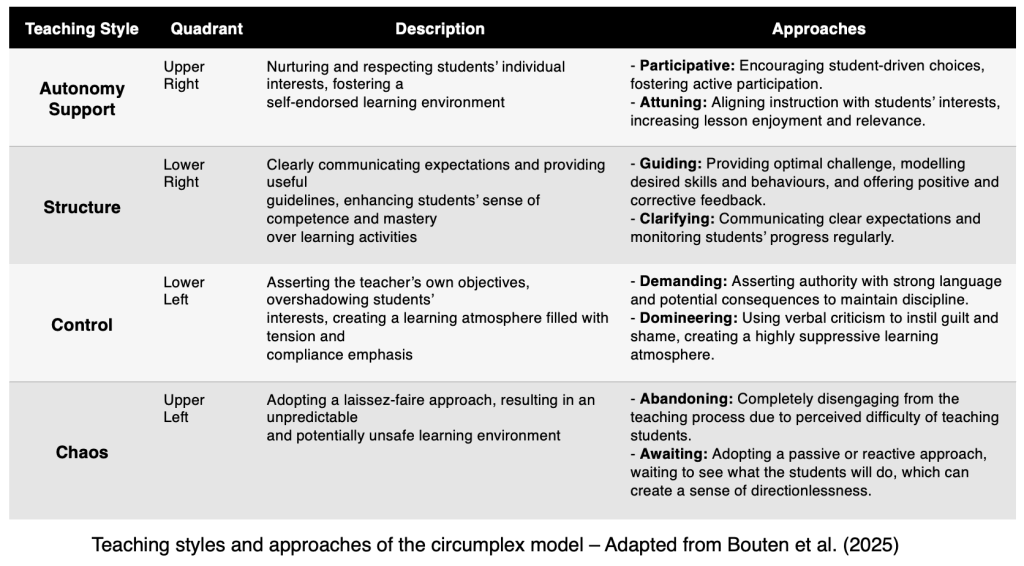
This is where Bouten et al.’s (2025) study becomes so important. Working with over 2,000 PE students across Spain and Belgium, they compared abandoning teaching (the most extreme chaotic approach) with domineering teaching (the most extreme controlling approach). Both were linked to negative outcomes such as autonomy frustration. However the abandoning teaching style stood out as particularly harmful. Across both samples, it was more strongly associated with overall needs frustration, especially for feelings of competence and relatedness. What this means, is without PE teacher’s providing purpose, structure, clear guidance and stepping in when required, pupils felt less capable and less connected.
The message for me is clear. If we are to become more intentional about reducing harm in PE, then when regarding these teaching styles it is the extremes we must worry about. When we talk about developing motivation, participation and belonging in PE, we should not just focus on avoiding overtly controlling teaching behaviours, but we need to also guard against the slow slide into chaotic practices. This is where model-based practice offers something valuable. Pedagogical Models such as Play with Purpose, Cooperative Learning, Teaching Personal and Social Responsibility, and Sport Education provide structure, routines, roles and responsibilities that provide clarity and security. Yet at the same time they also invite pupils to have autonomy, engage in individual and collective decision-making and to collaborate with their peers and the teacher. Pedagogical models help us to avoid the chaotic drift of “roll out the ball” lessons whilst resisting the urge to revert to instruction-heavy domineering control.
A recent systematic review and meta-analysis by Saiz-González et al. (2024) supports this. Pedagogical Models were consistently linked to higher satisfaction of pupils’ psychological needs and greater motivation in lessons. What makes these models effective is not that they hand everything over or tighten control, but that they offer a clear structure for learning while giving pupils meaningful involvement, voice and responsibility. In other words, they sit in the top-right of the circumplex model of teaching styles, which requires the PE teacher to provide high expectations of learning, clear support to achieve those expectations but also space for autonomy. It is a challenging way of teaching but it avoids the extremes of control and chaos that research shows can undermine motivation and enjoyment in PE.
The paper by Bouten and colleagues (2025) is a nice reminder to me that good teaching in PE is not merely about what we add, but also what we avoid and remove. If chaotic teaching is indeed as harmful as this study suggests, then it is the PE fields’ responsibility to not only develop and apply autonomy-supportive teaching styles, but also explicitly name, notice and reduce abandoning teaching behaviours in all their subtle forms. Not because it is rare, but because it is easy. Particularly at the end of term when energy levels are running low and external pressures of wider school responsibilities are taking their toll on the offer of quality PE. It is our professional and ethical responsibility to hold the PE space, not to leave it.