

First and foremost it’s important to name: our bodies change as we age, regardless of our lifestyle. That’s something to work with, not to fear!
Human bodies seek efficiency by responding to the demands imposed on them. What we repeat, we get excellent at repeating (even when it isn’t skillful- like always arriving in the same posture for things even when they’re uncomfortable/painful). Similarly the movements that we don’t repeat, we lose access to “just doing” on command. This is why people equate aging with losing skill- but that’s an incorrect equation. It isn’t the numerical age that matters as much as whether or not the motor elements of the skill in question are practiced regularly or not as we age.
We want to become aware of our habitual physical patterns so we can accurately learn more ease of coordination. We learn to start from where our bodies actually are meeting the material. This means adapting our thinking, our priorities, and our expectations about what movement practice should look and feel like so that we can notice and respond to our bodies’ needs responsibly in real time, rather than pretend we’re starting from some imaginary “neutral”.”
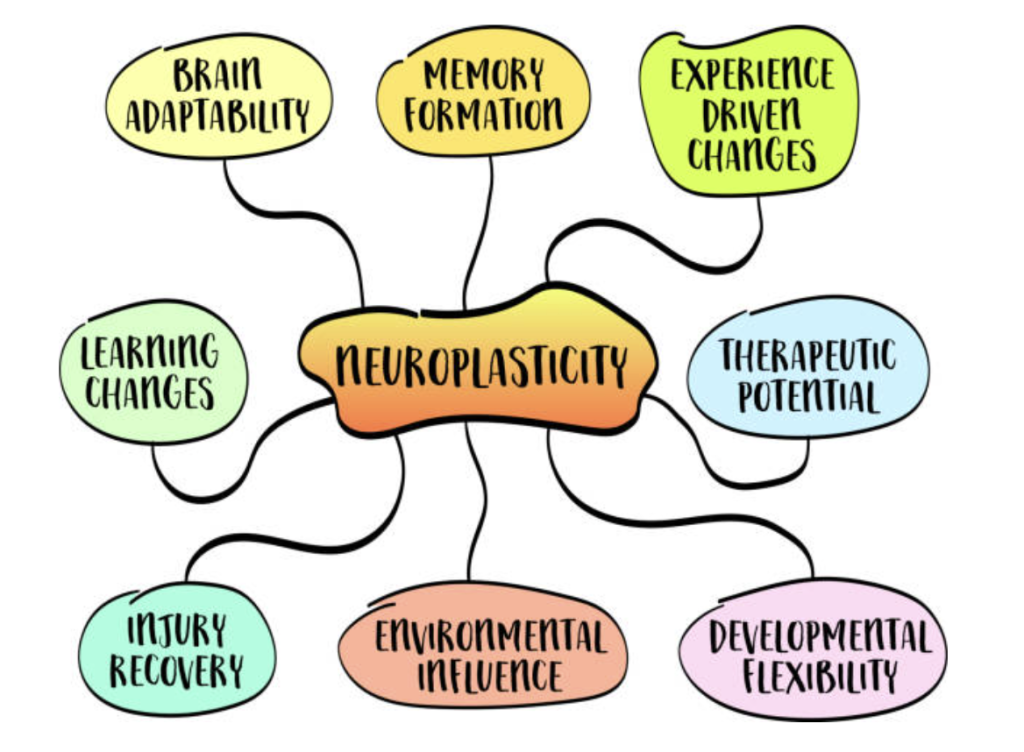
Here’s a brief and profoundly oversimplified neurology lesson to break down how this works:
Neuroplasticity is the process of our nervous system (which includes the brain) adapting new conscious and subconscious patterns and behaviors based on new information and experience.
As we age, certain conditions need to be met for us to intentionally shape neuroplasticity. For children, it occurs in their developing brains consciously and subconsciously all the time. After our mid twenties, our grown brains begin to seek efficiency rather than growth. From that point, neuroplasticity only occurs when our conscious attention is present to new information that can help us change our patterns and behavior.
Thus, in order to influence neuroplasticity as adults, we need to practice specificity when embodying attention.
Embodying attention is an act of noticing what is happening during movement and organizing our movement around integrated coordination rather than unconscious habits. It is the act of listening to/feeling sensations and allowing those to inform and refine our perception of our embodied experience moment to moment in service of harmonious movement.
The goal is to learn how to perceive and support the nervous system more specifically in cultivating integrated and graceful movement.
If interested in participating in a course on this material, one starts June 3rd and details can be found here.
[Feature Photo by Majkl Velner on Unsplash.]