
“I posit that there is virtually no distinction between what it means to become an expert teacher and what it means to become expert at making classroom and learning-related decisions.” (Knight, 2023, pg. 2).”
Bricoleur is a French word that means ‘a handyman who makes use of any and all the tools at hand to complete a task‘. I see part of developing expertise as a PE teachers through this lens. The first reason for this is that teaching PE requires the constant responding to persistent challenges. The second reason for this is that the PE teacher has many tools available to them, to use and adapt to meet those challenges.
How we a frame teaching is essential. That framing of teaching shapes many things including its purpose (vision), how we talk about it (shared language), how we judge its impact (reflection), how we introduce novices to the profession (initial teacher education) and continue to progress through our careers (professional development and learning). However we can frame teaching, and the understanding and categorising of the actions and behaviours of a teacher, in many different ways. Mary Kennedy calls this the ‘parsing problem‘.
In Kennedy’s (2016) review of this problem she highlights that we often frame teaching in three problematic ways:
1. Teachers do activities – this approach lists various job functions and attempts to cover everything a teacher might do, such as “giving pupils assignments.” In a physical education context, this could involve activities like organising games or teaching sports techniques. However, the problem with this method is that it can become cumbersome, as it may include an overwhelming number of items, making it challenging to determine what actions are truly critical for effective teaching.
2. Teachers make moves – this approach focuses on observable teaching behaviours, prioritising the specific actions teachers take in the classroom. For example, in physical education, this might include demonstrating proper technique or facilitating positive social interaction when working in teams. Although this method allows educators to identify clear behaviours, it often overlooks the intentions behind those actions. Teachers may perform certain behaviors, but without understanding the strategies that underlie them, the analysis remains superficial and doesn’t contribute to deeper learning.
3. Teachers enact core practices – this approach to framing teaching involves organising teaching practices according to the purposes they serve. In physical education, this could mean categorising activities based on their objectives, such as skill development, fitness, or teamwork. For instance, a lesson on cooperative games might be designed to foster social skills whilst also promoting physical fitness. The challenge here is that if we get novices to learn and imitate these core practices then they might become so procedural that their ultimate purposes are overlooked.
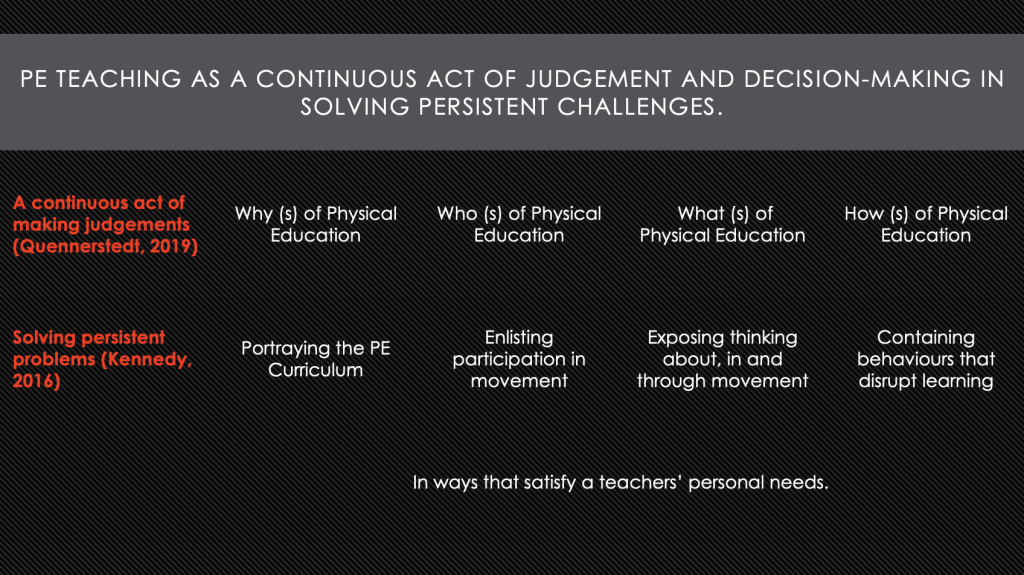
Understanding the purpose of what we say and do is essential to develop expertise in teaching. This leads to Kennedy proposing an alternative and integrated way of framing teaching, what she calls “responding to persistent challenges“. They are persistent because they are always ongoing, and never solved after a single lesson or intervention, but require the teacher to constantly navigate, adapt and respond over time. The five persistent challenges that virtually all teachers face are:
- Portraying the curriculum – is how a teacher goes about deciding on the knowledge, skills and behaviours we wish children to learn in PE, how we make sure that it is accessible and understandable to them as novices and then what activities are best suited to support that learning.
- Enlisting pupil participation – is about getting pupils to engage, not just to take part in the activities, but also in learning. In PE this is a constant challenge due to the embodied and performative nature of the subject, which requires children to “have a go” in front of their peers.
- Exposing pupil thinking – is about gaining insight into what pupils understand, don’t understand and misunderstand. Doing this consistently, in the moment, and over time allows teachers to make better judgements and decisions on whether what they are doing is effective and how to better support their pupils learning and development.
- Containing pupil behaviour – is about ensuring individual and collective safety as well as helping pupils to pay attention to what is being taught and not disrupting others from their learning. In PE, with the activities we provide this is always a constant issue to prevent embarrassment, shame, injury or worse.
- Accommodating personal needs – is about the teacher finding a way to address the four previous persistent challenges in a way that aligns to their own personality, beliefs and personal needs. Kennedy highlights that teaching is “intensely personal and inter-personal work” and that there are a variety ways that can effectively address the other challenges.
The final persistent challenge about accommodating personal needs, when addressing the others, leads to the second reason of seeing PE Teacher expertise through the lens of a bricoleur. The PE Teacher has a wealth of evidence-informed tools available to them. It can be considered both a blessing and curse that we have so many options, but personally I think it’s one of the best aspects of being a PE Teacher. Below is just a selection of styles, methods, models and approaches that can be used within PE to adapt and respond to the persistent challenges:
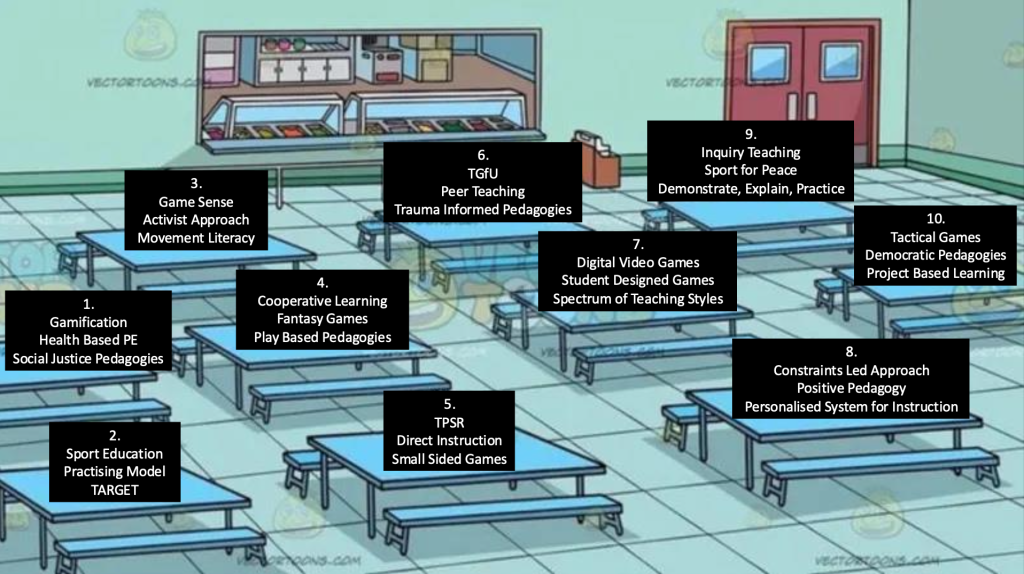
If PE Teachers want to successfully address the persistent challenges without causing harm, then they need to expand the range of tools they have. It is not enough to just have a hammer and being good at using it. This will only get you so far, until you meet a challenge that you can’t respond to that way. We need a set of screwdrivers, a utility knife, pliers, a tape measure, a level, a pencil, etc. In addition we need to get competent at using them, so we feel confident to draw upon them when the need arrises. This is not an easy task. It requires taking a risk, being patient and practising with them over an extended period of time. Learning to use a new tool (like Cooperative Learning or Sport Education) can, from my experience, take years. Also it is not just you as the teacher who is learning to use the tool, but also the children in your class. However with practice comes competence and confidence, and this leads to the capability to adapt, refine, and combine them to fit to different contexts and needs. This is not a short term endeavour, but a career long one.
It isn’t just having a set of tools that is important, being competent at using them or learning how to adapt to a specific context. It is about having knowledge of how these tools affect pupils learning experiences and development and where they might help or hinder responses to the persistent challenges PE teachers face in their day to day job. As Amy Price wonderfully puts it “the skill of teaching is to make informed decisions about which tool(s) to use, how, with whom, when, why (and why not)“. This for me is a foundational element of PE teacher expertise and how we as a profession go about supporting children to develop knowledge, skills and behaviours which will allow them to find the value in a physically active life.