

In the last post, we worked through the most probable causes of a shoulder problem—first locally, then one degree out. Most problems get solved somewhere in that process. But not all of them. So what happens when you’ve genuinely run out of neighbors to check?
In this post, we march into murky uncertainty. The further we stray from the problem, the more obscure the logic, and the harder our brains must work.
As a rule, we must find something we’ve never done to get an outcome we’ve never had. So what else is there? What else could be causing the problem? We need to find a connection, a relationship, a through-line of one thing affecting another. The connections are either anatomical links, like the muscles we discussed with John’s shoulder (a weak upper trap created a low scapula that didn’t upwardly rotate well), or something I call a “task link.” We’ve covered anatomical links. Now let me explain tasks.
The brain doesn’t move the body where you’re strongest or weakest or in the path of least resistance; it moves the body in ways that accomplish tasks. It puts one foot in front of the other, it puts the lime in the coconut. The brain accomplishes tasks regardless of the body’s structural integrity. It will use structurally different elements to get the output you desire. This is both a risk and a reward of being a complex mover. This substitution is called a “degeneracy.”
For this example, we’re going away from John’s shoulder and onto a runner’s shoulder.
Tasks & degeneracies:
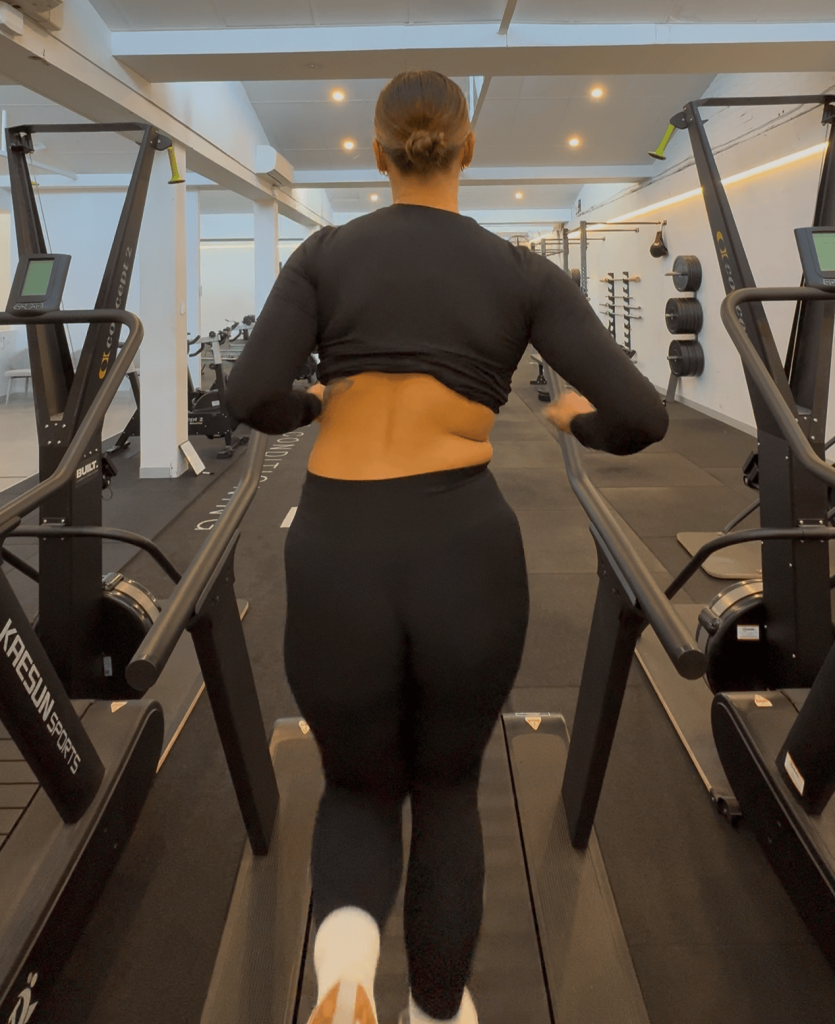
Look at this photo. See the right shoulder flailing out to the side?
Let’s say her right shoulder aches a little, and she’s trying to become a more efficient runner because she’s got a marathon on her mind. Why would she shift her ribs and arm so far to the right while on her right leg? What does this accomplish?
The brain is constantly working to balance the center of mass over the center of pressure. When standing, walking, and running, the center of mass (COM) should balance over the center of pressure (COP). The faster you move, the less side-to-side shifting is necessary because momentum carries us forward. Our hips and ankles specifically evolved for this bipedal balancing act, and they have the mechanical advantage and the leverage for it.
When she shifts her ribs and arm to the right, it gets her center of mass over her foot. It works. But the shoulder and ribcage aren’t the best structures suited to that task while running. The hip and ankle are.
While we may still need a local solution, like making her shoulder (deltoid?) strong enough to tolerate this pattern, the cause is how she shifts weight onto her right leg. Instead of her current pattern, she needs more ankle eversion and hip adduction. Those movements use the structures best evolved for the purpose.
If improving ankle eversion and hip adduction doesn’t work, then I’d consider what else is necessary in that phase of running. So what else is necessary in this phase?
It’s left thoracic rotation. That becomes the next option to test. Notice the structure of that reasoning — it’s the same scientific method as before, just applied further from the site of the problem.
The search is the point
This kind of logic is rock solid and necessary if you’re going to be implicating distant causes. You must be willing to admit you’re lost for a while to find these solutions. They don’t just spring up out of nowhere; you must find them. You must search.
But I’m stopping our search here because this is long. Do you see how maze-like this becomes once we open ourselves up to non-local causes? We may need to navigate this maze, but it’s so hard. Which is all the more reason I want to exhaust local solutions before entering this labyrinth.
Do you see how maze-like this becomes once we open ourselves up to non-local causes? It’s so hard. Which is exactly why we enter this maze last, after local options and nearest neighbors are exhausted.
If you want to build this kind of reasoning until it becomes instinct—staying rigorous when the logic gets murky and the answers stop being obvious—that’s exactly what we do in the Evolved Coach course. Next course begins March 30, and registration is open now.
Distant causes are messy, hard to find, and sometimes improbable. While I’m looking for these, I may be simultaneously wondering if it’s a systemic problem, something wrong with the whole body. Systemic causes are coming next…
*****
So far in this series, we have three types of problems: local, distant, and now systemic. Local problems are like this: there’s one or two pieces of the body that aren’t up to snuff. You isolate and improve those pieces—pieces we proved needed help—and then reinsert the improved part into compound movements and daily life.
Distant problems are when the cause lives further from the symptom, connected by an anatomical or task link, like the runner whose shoulder and rib cage were compensating for what her ankle wasn’t doing.
But then there are systemic problems. The semi-obvious ones are underfueling, undersleeping, and overtraining, which destroy even the greatest training plans. But what are systemic problems in movement?
We need to zoom out and see the big picture, because it’s so easy—for me and probably for you too—to zoom in and search for an individual piece that needs improving. For systemic problems, I’m going to use running as our vehicle, because it involves many overlapping systems.
STRESS FRACTURE PROBLEMS
Some systemic problems look mechanical at first. If you see a stress fracture in a runner’s fifth metatarsal, it’s tempting to blame mechanics, lack of strength training, or just too much running. And it might be that! But if you know the right questions to ask and what other causes could be, you might also realize this stress fracture could be the effect of a systemic cause, like low ferritin levels. That’s when you refer out to someone in your network—you need a network—for bloodwork.
RUNNING STIFFNESS PROBLEMS
Running without stiffness can be the culprit of foot, lower leg, or knee issues. Most recreational runners have this problem. People hit the ground like a bag of milk, get to end range dorsiflexion — the longest length of their soleus, post tib, and other muscles — and then try to get off the ground again, thousands of times a run, multiple times a week. This soft strategy can cause a muscular ruckus.
Or they hit the ground softly, their hamstrings try to control the ground reaction forces, momentum carries their mass forward, and then their quad and calf create some weird pseudo hip extension. And then problems ensue. (Here’s a link to a paper discussing this.)
We have two solutions for stiffness problems:
- If you can’t beat ‘em, join ‘em. Give them the local capacity to handle a soft landing. Give the runner the strength and endurance at long muscle lengths: lots of loaded and unloaded calf raises, pausing at the bottom. Include a lot of quad strength and endurance in running-specific positions like a quarter squat because “the knee extensors primarily regulate ankle joint quasi-stiffness during propulsion at lower speeds.” (Chen et al., 2025)
- Increase vertical stiffness, muscular stiffness, through well-executed plyos. (If these problems sound like your problems, I offer many solutions in Ultra Legs.) Stiffness isn’t only a tissue change; it’s how your brain times and coordinates muscle-tendon behavior in fast movements. (Kubo et al., 2017) Having more stiffness keeps muscles at more affordable lengths and makes runners more efficient.
RUNNING ENDURANCE PROBLEMS
Let’s roast me and my running here. I want to be able to run long distances, anywhere in the low double digits will do, mostly for the benefit of my dog, Loki. But I guess for my health and longevity, too. Mostly him, though. There are multiple systems we can test to explain my shit performance:
✔ CO2 Tolerance
CO2 is a toxin. We exhale to get rid of it. But just like the Dread Pirate Roberts grew to tolerate iocane poison, we can become tolerant of CO2.
If we are intolerant—and so many people are—they must breathe faster to exhale more CO2, raising their heart rate (and, if they are mouth breathing, expelling more water). Low CO2 tolerance is bad for running efficiency. If your exhale is under 20 seconds, you got problems. My CO2 tolerance is fantastic; I can continuously exhale for 90 seconds. This is not my problem.
✔ Power
Some people just don’t create enough force fast enough to get off the ground quickly. I used to have a 42-inch vertical leap and can still dunk any day of the week without a warm-up. This is not my problem.
❌ Muscular Endurance
I only put this last so I could build myself up before embarrassing myself. My muscular endurance is awful. I’m working on it, but I prioritize heavy lifting for my tendons, mental health, and hormonal health. I lack the mitochondrial efficiency and density to run long distances. No matter the run, eventually my HR soars, my blood sours, and my ego suffers.
Some people develop quad, hamstring, and hip problems because they lack the calf endurance to run long distances So, work shifts upward to bigger, more metabolically expensive muscles.
SYSTEMS ON SYSTEMS
Sometimes you must target one system, like the cardiovascular system. Or maybe it’s the whole damn leg and how quickly your brain tells you to get the fuck off the ground. But often the systems are stacked, with each one depending on the others. Vertical stiffness in running is a good example of this. Let me show you.
To run efficiently, you need the overall muscular strength to overcome roughly 3x your bodyweight each step of a jog. You need to create that strength quickly enough to get off the ground before your muscles get too long, aka muscular stiffness. You need the endurance to repeat these actions over and over. And because increased stiffness puts a greater elastic demand on your tendons, you must also prioritize heavy lifting to take care of those. Then there are the metabolic and cardiovascular systems that must also be tested and developed. Systems on systems on systems. Running well and with low injury risk is complicated.
SYSTEMS RELY ON THE QUALITY OF LOCAL INTERACTIONS
Here’s where we come full circle. Complex systems work because of local interactions. You can’t overlook local interventions just because you’ve identified a systemic one. Good stiffness doesn’t mean your calf has the capacity to run without risk.
Runners who come to me with lower leg pain still get local solutions: calf raises till they die. But they also get systemic interventions, like hopping for stiffness, so they don’t hit the ground like a bag of milk and risk damage to their lower leg tissue integrity.
The through-line connecting every piece in this series is this: you need to understand the problem you’re working on and how things interact within the body. The body is complex and hard to understand, and I won’t pretend to know all its secrets.
But we can’t make up stories about how someone’s shoulder pain is caused by a hip to cover up the uncomfortable truth that we just don’t understand what’s going on locally, that there might be something under our noses that we just don’t see yet. Making peace with that ignorance, in the session, with the client in front of you, is the first step to finding it.
I wrote this whole series, and I feel like I understand how things are connected, and yet I keep returning to something I wrote in the first post: every time I start looking at distant causes, I usually find something local that humbles me. Something right in front of me that I never saw and didn’t even think to look for. It makes me uncomfortable too.
Systemic and distant problems exist, but shit, so many problems are solved locally. We just need the time, patience, and intellectual humility to admit there might be something we don’t yet see.
This is the work we do in the Evolved Coach course, building the kind of thinking that lets you search intentionally, fail usefully, and find what’s hiding in plain sight. If that’s the coach you want to be, take my course. The first day of class starts March 30.
[Feature Photo by Koushik Chowdavarapu on Unsplash.]