
There are two things I’ve learned in 23 years of working one-on-one with clients:
- We fear what we don’t know.
- Movement creates more movement.
From a movement perspective, fear shows up when:
- You don’t know where you’re going.
- You don’t know what the movement will feel like.
- You don’t know how to execute it in a way that feels safe.
That last one is especially important. It shapes how people approach movement in gyms and classes. Many people fear doing exercises “wrong.” That’s one of the reasons they hire a coach, join group classes, or follow structured programs. In fact, it’s one of the driving forces behind many certification systems.
 But here’s the truth: most of the ways we move in daily life don’t look anything like how we’re “supposed” to move in the gym. And that makes sense—if you don’t routinely lift heavy objects in your everyday life, the gym becomes the place to practice doing so.But is there really a single “right” way to move? And what if what’s considered “right” is only right under certain circumstances—and not others? After all, when was the last time you lifted a perfectly symmetrical, evenly loaded, horizontal object outside the gym?
A Lesson from the Highland Games
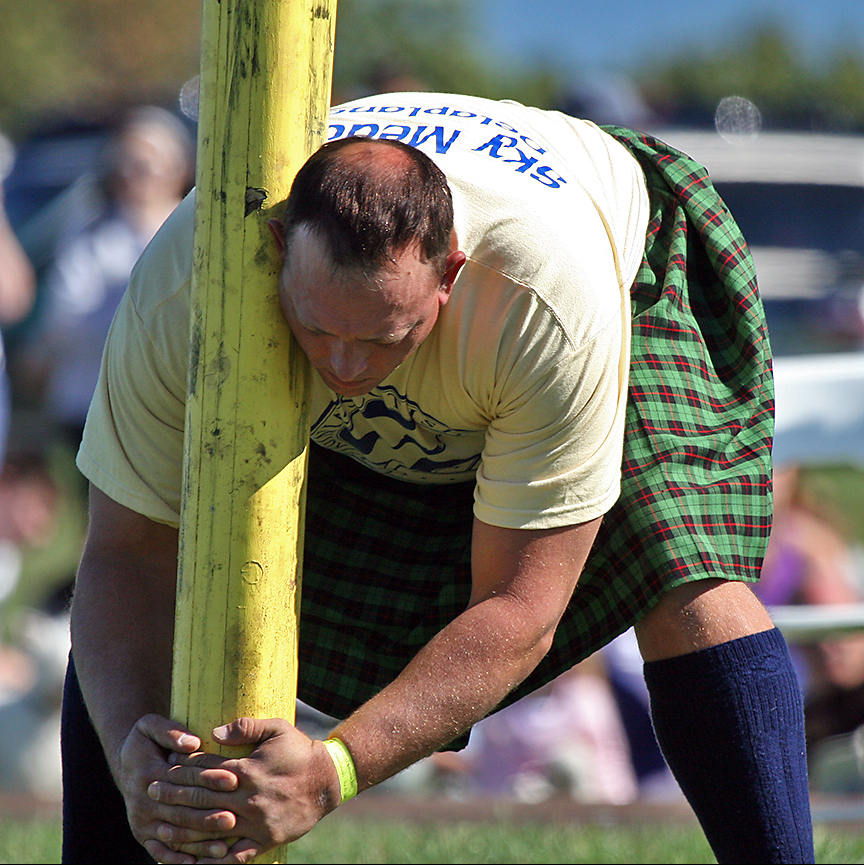
The video below highlights the Highland Games, a Scottish tradition dating back to the 1000s and revived in the 1800s. Events include throwing a stone, tossing a tapered pole called a caber, and heaving a half-barrel beer keg over a bar.
The athletes are undeniably strong, but if they used these same techniques in a gym, a well-meaning trainer would probably step in to “correct” their form to prevent injury.
And yet—injuries are rare. A 2016 study found that for every 1,000 hours of training, about 7.5 injuries occur (source).
That’s 0.0075%.
Put another way: if someone trains five hours a week year-round (260 hours/year), it would take four years to accumulate 1,000 hours. Over that time, their chance of injury would be only 0.075%.
And remember, these people are hurling kegs over high bars.
Fear Less, Move More
The chances of hurting yourself when you don’t execute a movement “perfectly” are extremely low—especially if you build gradually. You don’t start by throwing a half-barrel keg. You start with something light, roughly the same shape, and experiment:
-
-
-
-
-
- Maybe you just throw it and see where it lands.
- Maybe you pay attention to your throwing mechanics.
- Maybe you focus on the timing of the release.
-
-
-
-
-
- Through trial and error, you find a method that works. Over time, you increase the weight, refine your technique, and eventually, efficiency becomes the goal. At that point, fear is gone—the movement is no longer unknown.That’s why, in my recent six-week handstand course, I spent so much time teaching people how to fall. Falling is the scariest part of a handstand. Once people become comfortable with it, they’re free to actually try.
Feature Photo by Steve from washington, dc, usa (via wikipedia) – a man and his caber, CC BY-SA 2.0